
Installing and managing TAO Community Edition

This guide explains how to install TAO Community Edition (TAO CE) using Docker, and what to do next after installation.
Container
TAO CE supports deploying its resources as a container using Docker for local development and evaluation.
Prerequisites
Install Docker for your environment by visiting Get Docker.
If you are using Docker Desktop, allocate at least 4 GB of memory.
Open Docker Desktop.
Go to Settings > Resources > Memory.
Adjust the memory allocation if needed.
Retrieve and deploy the TAO CE container
The core TAO CE resources are hosted on http://quay.io/tao-ce/tao-ce:latest . Follow the steps below to pull and deploy the container.

If you have previously installed TAO CE, delete all existing TAO CE containers, volumes, and images from Docker before continuing.
Steps
Download the ZIP archive containing the
docker-compose.tao-ce.yamlfile from the following URL and unzip it:
https://gist.github.com/tao-community-edition/5ac924d5021aa2d7d3635064edc0e752/archive/eb21e720043a3278655516ae1e5993ef6ca2e3f4.zipOpen a terminal or command prompt.
Navigate to the folder where the ZIP file was extracted.
Run the following command:
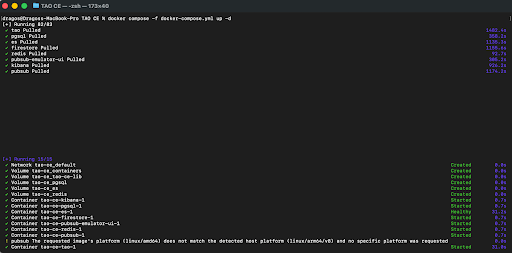
docker compose -f docker-compose.tao-ce.yaml up -dWait for all volumes to be created and all containers to start. When the process completes, the services should be running successfully and you will see something like this:
Optional hosts configuration (recommended)
Configuring a local host entry simplifies access to TAO CE.
Linux and macOS
Open the
/etc/hostsfile with administrator privileges.Add the following line:
0.0.0.0 community.tao.internalSave the file.
Windows
Open
C:\Windows\System32\drivers\etc\hostswith administrator privileges.Add the following line:
127.0.0.1 community.tao.internalSave the file.
Access TAO CE
Open a web browser.
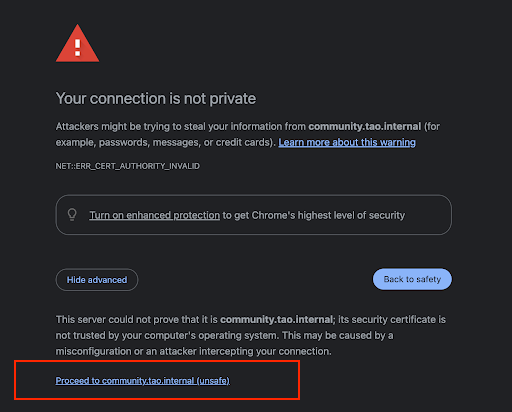
If a certificate warning appears, proceed to community.tao.internal. In Chrome, for example select Advanced > Proceed:
Log in using the default credentials:
Username: admin
Password: password
Immediate action required: change passwords
For security reasons, all default passwords must be changed immediately after installation.
Change the admin password
Click your user avatar in the top-right corner.
Select My account.
Click My user.
Click Change password.
Enter a secure password with at least 8 characters, including at least one lowercase letter, one uppercase letter, and one number or symbol.
Click Save changes.
You may see a warning that your password is not safe enough, despite following the recommended constraints. You can ignore it, as this is a known issue which will be resolved in a future version.
Change test-taker passwords
The following test-taker users are preconfigured: demo01 to demo05. The default password for each user is password.
Steps
From the Portal, click the Users tile.
Locate the users with the Test taker role (demo01 to demo05).
For each user:
Open the context menu.
Select Edit.
Click Change password.
Enter a secure password.
Click Save changes.
Performance expectations
Concurrent users
The system has been tested with up to 500 concurrent test-takers, using a ramp-up of 25 users per second. All test-takers were able to submit their tests successfully.
Login performance
At 500 concurrent test-takers, login delays of up to 1–2 minutes were observed. All users were eventually able to log in.
At 200 concurrent test-takers, login delays were acceptable, with a maximum delay of approximately 7 seconds.
What to do next
After installation and password updates, follow the steps below to create and deliver a simple test.
Prepare content (items and tests)
From the Portal, click the Content Bank tile.
Open the Items tab.
Create folders and items as needed.
Switch to the Tests tab.
Create a new test.
Add the items you created to the test.
Select the test and click Publish to create a new delivery.
Create a group
A group is a collection of users with assigned roles, typically used to organize test-takers.
From the test authoring area, click the back arrow to return to the Portal.
From the Portal, click the Groups tile.
Click Create group.
Enter a name for the group.
Open the Users sub-tab.
Select the users to add as test-takers.
Save the group.
Create a session
A session connects a delivery (published test) with a group of test-takers.
From the test authoring area, click the back arrow to return to the Portal.
Click the Sessions tile.
Click Create session.
Enter the following information:
Session name
Group
Delivery
Click Save.
Simulate a test-taker
Log out of the admin account.
Log in as a test-taker user (for example, demo01).
In the session list, locate the session you created.
Click Start.
Complete the test.
Evaluate test results
Log out of the test-taker account.
Log back in as the admin user.
Go to Sessions.
Locate the session and click Enter session.
For each completed test, click Review to view results.
Other relevant resources
Known issues
The following issues are known in TAO CE version 2025.10 and are planned to be addressed in future releases.
Issue | Workaround / Notes |
Text-to-speech is not working for the test-taker | No workaround available yet. |
Usage tab for items is not working | No workaround available yet. |
Item statistics tab for items is not working | No workaround available yet. |
Changing the password for the current user throws an error about constraints not being met, despite following the constraints | Ignore the warning, as the password is actually updated successfully if the constraints are met |