
The Media Interaction allows Test-takers to view a multimedia presentation (image slide show, YouTube video, etc.), usually in connection with another interaction.
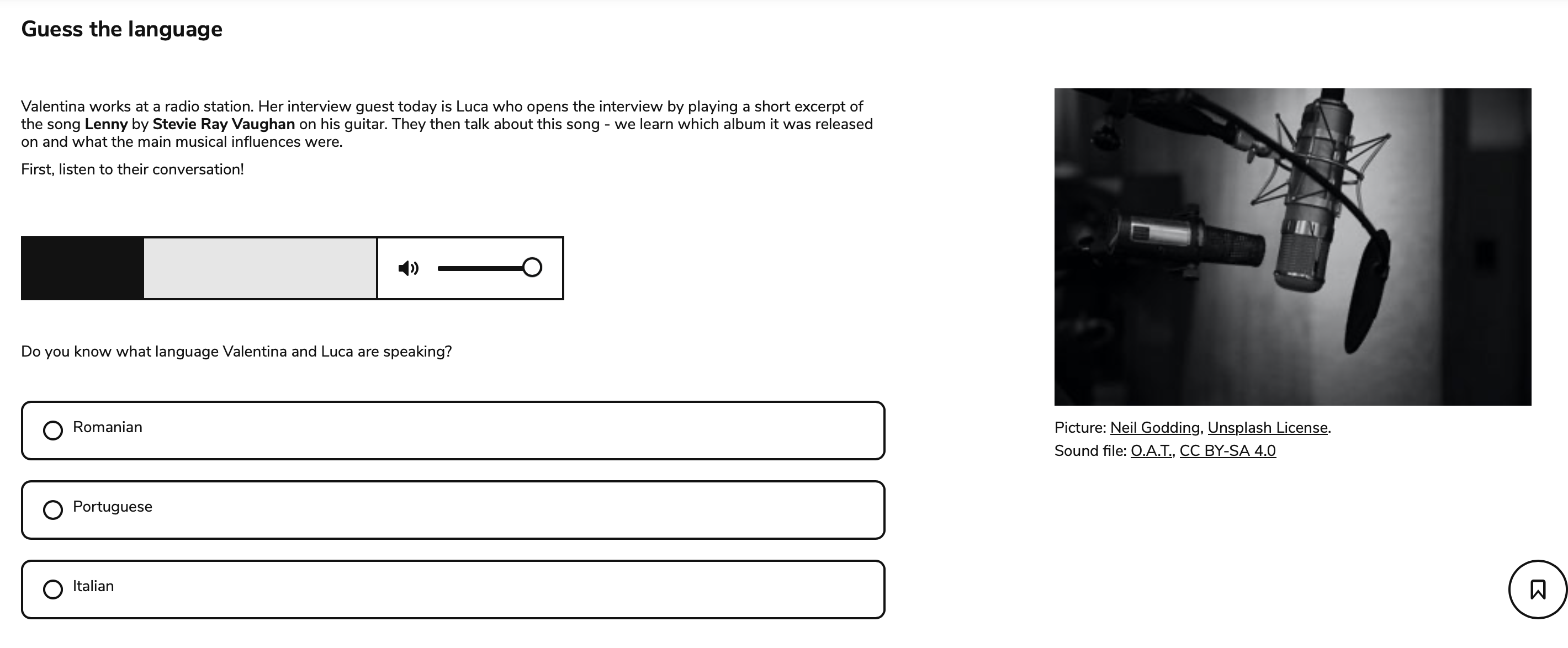
Once you have generated a new Item, and clicked on Authoring in the Action Bar, follow the steps below to create a new Media Interaction:
1. From the Common Interactions Library on the left, drag the Media icon onto the blank item and drop it onto the Canvas.
A Resource Manager window will appear with which you can select a media file. You can re-use a media file already in the resource manager, or you can upload a new one (note that size and file type restrictions apply).
-
To select one from the list of previously uploaded media, highlight the appropriate one in the resource manager list and click the green Select button.
-
To upload a new one, click on the blue Add file(s) button to browse the files on your computer, and then upload one to the resource manager by clicking the green Upload button.
Highlight the file you have chosen as your background by clicking on it, and it will appear on the right in the preview panel. Click Select in the bottom right of the window to continue.
Alternatively, exit this resource window and enter the web address of an online video or audio resource in the box entitled Media file path or YouTube video address in the Interaction Properties Panel. See here for supported media formats.
A new authoring window will appear with the media shown in the center of the canvas. Above the media file there is a question field.
Important: Please note that Media Interactions accept audio and video files as part of the interaction. Only available audio and video files will display in the Resource Manager.
To add an image to the interaction, click the Insert Image or Insert Media icons from the word processing toolbar (Word Processing Options). Images can be added after clicking the text box for the prompt, or using a Text Block from Inline Interactions.
2. Fill in the question field, where it says define prompt.
This will describe the task given to the test-taker (“View the following film”, “Listen to the inflections in the following sound recording”, etc.).
See the chapter Word Processing Options for details on text editing options such as using italics or bold text in your item, and inserting features such as shared stimuli or media, tables or formulae.
3. Configure the interaction in the Interaction Properties panel on the right.
Set the playback method of the media device.
These property options will affect how the test-taker views/hears the media object while it is playing.
-
Determine the size of the screen on which the video or audio will play in the Width and Height boxes.
-
Check Autostart if the media device should begin playing when the interaction is opened. For more information on Autostart options, see the section below.
-
Check Loop if the media device should play over and over again. If this is checked, enter the number of times you wish the loop to be repeated in the Max plays count box.
-
Check Pause if the test-taker is permitted to pause and restart the media device during the interaction.
Autostart options
Additional configuration can be done to control auto-playback, as well as defining an optional delay for it. This feature is typically used for media interactions with audio files.
-
In Interaction properties, select Autostart to enable automatic playback. Add (in seconds) how long the pause should be prior to automatic playback.
-
If you select Autostart, the Display media player option will be enabled by default. This configuration plays the media immediately (after 0 seconds by default), though test takers will be able to interact with the media player to pause, rewind, or adjust volume.
-
Select Autostart and Loop if the playback should be automatically and continuous (until the Max Plays Count number is reached, if configured).
-
-
Select Sequential to adjust how many repetitions of the audio playback should occur. Additionally, configure (in seconds) the delay between repetitions, and the delay after all repetitions have completed.
Enabling Display media player (after enabling Sequential mode) cancels any adjustments to Sequential mode. The Loop and Pause options will not be available for selection if Sequential mode is selected.
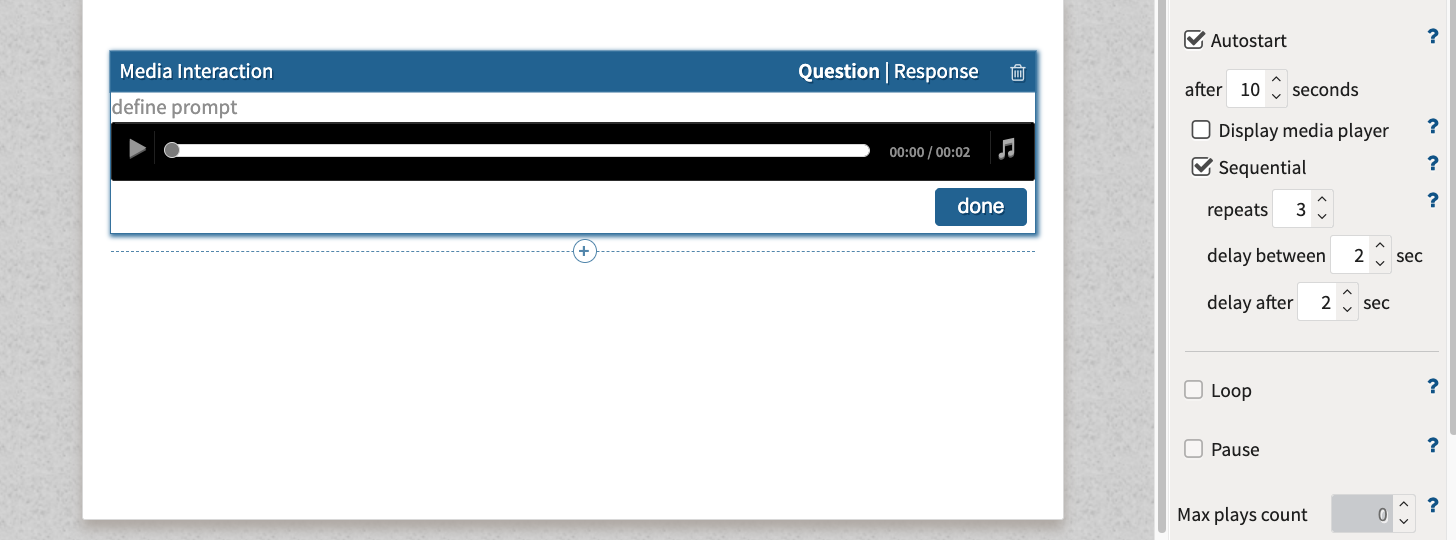
Using Autostart in a sequence of items
Audio files can be sequenced together across multiple interactions, where test navigation progresses automatically to the next item in the sequence. If autostart is enabled, audio files will play automatically (and potentially repeat). Once the audio file and any repetitions are complete, the test taker will be moved to the next item.
Using Sequential mode is helpful when creating tests where the test-taker is supposed to listen to an audio file without being able to interact with it, either to then answer questions related to it (for instance, assessing their listening ability) or as additional information about the test.
-
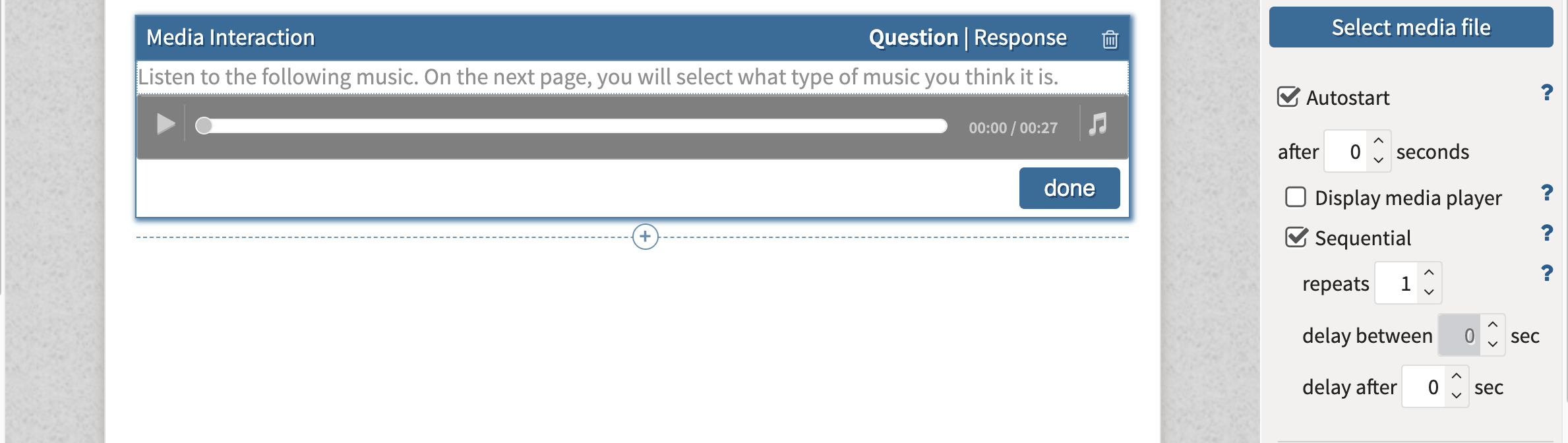
In the media interaction’s Interaction Properties, configure Autostart > Sequential mode.
-
For this mode to be activated for one or more items during a test session,
x-tao-sequence-ended-nav-nextmust be added as a Category to those items during test authoring (for linear navigation) -
For all instructions on configuring this feature, see How to configure automatic navigation in the Knowledge Base.
Audio player options
If you are using an audio file, you have the option of limiting the media player’s visible buttons. Check the Compact Appearance box to display the Play button only.


4. If desired, add a further interaction to the media interaction.
Usually, a Media interaction is used to present a film or sound clip, to which a series of questions may be added. Drag the appropriate interaction type from the Common Interactions menu on the left, and consult the the steps in the user guide topics for help on how to execute this interaction.
5. Click the blue Done button. Your media interaction is now complete.
You can now preview your Interaction using the steps given in step 6 of Creating a test item.