
Portable Custom Interactions (PCIs) are Interactions which are developed for a specific scenario, generally to fulfill a particular need of a customer, hence are not classical QTI interactions. PCIs represent a best practice for defining and packaging custom interactions. Unlike classical Custom Interactions, they interact with the test runner (standardized APIs), allowing them to be ported from one system to another.
TAO Core (deprecated): The following six types of PCI are part of the TAO Core package: Audio, Likert, Liquid, Entry Code, Math Entry and Text Reader. The others (Fractions, Graphing Function, Graphing Line & Point Function, Graphing Number Line, Point Graph, and Graphing Zoom Number Line) require the installation of a separate extension.
TAO Ignite: TAO Ignite has the following custom interactions: Audio, EtherCalc, Math entry, Text reader, Fractions, GeoGebra, Entry Code, Graphing f(x), Line & Point, Number Line, Point Graph, Zoom Number Line, Likert Score.
For more information, see https://www.imsglobal.org/assessment/interactions.html.
Adding PCIs via item authoring
The Portable Custom Interactions library is under the Graphic Interactions library on the left:
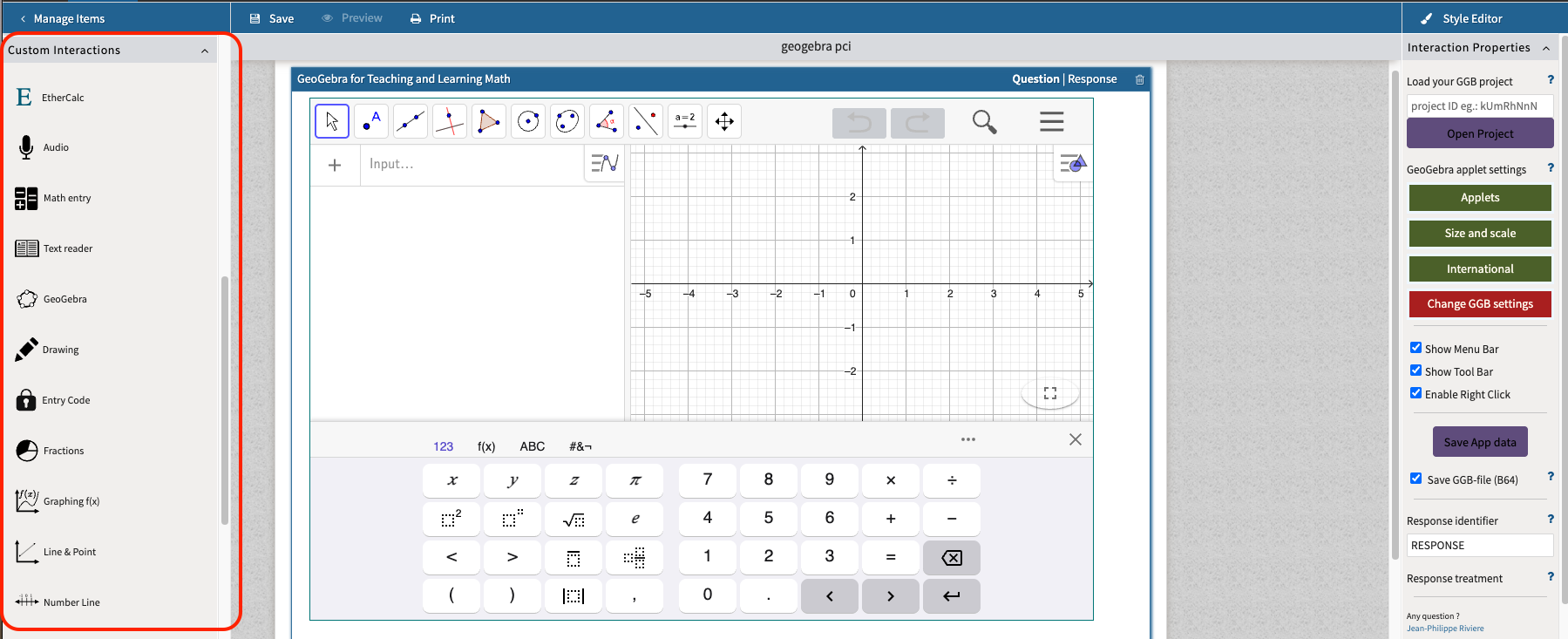
See the separate topics in this section on each of the PCI interactions for information on how to use each one.
To create any of these types of interaction, once you have created a new Item, click on the Custom Interactions library and drag the appropriate interaction type onto the blank Item, drop it onto the canvas, and then populate the Item.
Uploading PCIs to TAO
In TAO, an administrator can add any PCI to the platform, even if it's not installed by default; TAO can accept any PCI that follows the standard.
There are two ways to upload PCIs to TAO:
-
Importing a QTI 2.x package that contains PCIs in the items.
-
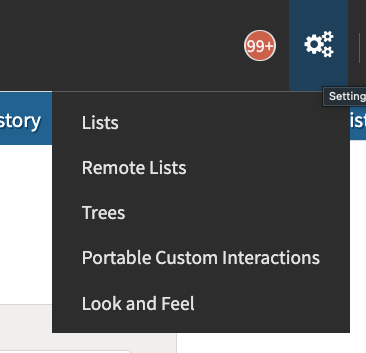
Via the settings (cog wheels icon) in the top right part of the Content Bank:
-
Click on the Portable Custom Interactions.
-
From the resulting page, click the Add interaction button to upload a PCI from a local system.
-